Workshop on Managing Digital Transformation in the Health Sector
About
DiTH – Digital Transformation in Health is an international conference bringing together researchers, academics, public administrators, and industry professionals to explore the latest developments in digital health and healthcare innovation. Organized by the ManagiDiTH Consortium and supported by the Digital Europe Programme, the conference will take place on 2–3 November 2026 in Thessaloniki, Greece, fostering collaboration, knowledge exchange, and discussions on the future of digital transformation in health.
Date: November 02 – 03, 2026
Location: Aristotle University Research Dissemination Center (KEDEA), Thessaloniki, Greece
Welcome!
We are pleased to announce the upcoming conference DiTH – Digital Transformation in Health, an international forum dedicated to advancing research and innovation in the fields of digital technologies, healthcare applications, and interdisciplinary digital health applications. The conference is organized by the ManagiDiTH Consortium under Project No. 101083896, partially funded by the Digital Europe Programme of the European Commission. The conference serves as a dynamic platform for exploring innovations in health, for the exchange of cutting-edge ideas, methodologies, and practical developments, bringing together researchers, academics, public administrators, and industry professionals.
DiTH fosters collaboration across disciplines, encouraging discussions on emerging challenges, novel technologies, and future directions in the rapidly evolving digital health landscape. Participants will have the opportunity to engage with high-quality scientific contributions, inspiring keynote talks, and valuable networking activities.
DiTH 2026 will be conducted exclusively as an in-person event. All presenters and participants are expected to attend physically, promoting meaningful face-to-face interaction, collaboration, and professional engagement throughout the conference.
The event will be hosted at KEDEA BUILDING, the Aristotle University of Thesaloniki Research and Dissemination Centre, offering modern conference facilities and convenient access to cultural attractions, local cuisine, and vibrant city life, ensuring both a productive and memorable experience for all attendees.
Further information regarding important dates, paper submissions, registration, and the technical program will be announced soon through the official conference channels. Stay connected for updates and join us in shaping the future of digital transformation in health.
DiTH 2026 will take place in November 2-3, 2026 in Thessaloniki, Greece.
Funding opportunities
Important dates
DiTH 2026 is committed to fostering participation from emerging researchers and innovation stakeholders. In this context, scholarship opportunities and financial support for conference participation are expected to be offered to students of the MANAGiDiTH Master’s Programme, encouraging active engagement with the international research and innovation community.
In addition, a limited number of entrepreneurs, startups, public sector administrators, and cluster or collaborative innovation projects may also be eligible for participation funding. Through this initiative, the conference aims to strengthen connections between academia, industry, public institutions, and the entrepreneurial ecosystem, creating opportunities for collaboration and knowledge exchange.
Participation Type 1. On site participation for ManagiDiTH students
- Full papers. Papers from 5 up to 7 pages presenting completed work, such as dissertation outcomes or other finished projects. Accepted full papers will be presented orally during the plenary thematic sessions.
- Abstracts for oral presentation. Accepted abstracts in this category will be presented orally during the plenary thematic sessions.
- Abstracts for poster presentation. Accepted abstracts in this category will be presented as posters during the Conference. Posters must be prepared in A0 portrait format and will be displayed in electronic format.
PARTICIPATION TYPE 1 HAS EXPIRED
Participation Type 2. On site participation for entrepreneurs, startups, cluster projects from Europe or Greece
- Accelerating Demonstrations. Startups, SMEs, tech providers, health services administrators, public administrators and cluster projects in the field of digital transformation in health are invited to demonstrate their innovations or project results. Accepted contributions will be presented in the format of pitches or conference booths in specific thematic sessions.
All contributions must present original work. Abstracts may report early-stage findings as well as the outcomes of completed dissertations or projects. The Scientific Committee assigns the final presentation format (oral or poster and pitch or booth), taking authors’ preferences into account.
All contributions will be peer-reviewed. All accepted abstracts and papers will be published in the conference proceedings, while the accelerating demonstrations will be mentioned in the form of a list of participating industry representatives.
PARTICIPATION TYPE 2 HAS EXPIRED
Participation Type 3. On site participation for postgraduate students from EU Member States, EEA countries or Switzerland.
- Thesis Master Class participation. Accepted applicants will co-organise a thesis master class within the DiTH 2026 Conference to exchange experiences, receive expert guidance and further develop thesis methodologies and tools. Applicants will be requested to fill in an application field providing a motivation statement (up to 100 words) outlining their thesis topic, current stage of research, and the methodological or practical challenges they wish to address.
REGISTRATIONS OPEN UNTIL 07.10.2026
Available Funding:
Participation Type 3. On site participation for postgraduate students from Europe or Greece | |
| € 850,00 € 580,00 € 230,00 |
The number of available scholarships for Type 3 participants is: 255 scholarships
Eligibility and exclusion criteria for Type 3
Participation Type 3. On site participation for postgraduate students from Europe or Greece | ||
Criteria Type | Definition | Evidence |
Selection | Applicants who currently are enrolled in a postgraduate course or have graduated between 01/2026 and 12/2026. | Certificate of studies |
Exclusion | Applicants who have applied under more than one Participation Type. Applicants who are not EU, EEA, or Swiss nationals. Applicants may not receive double funding from European Commission programmes for the same activities or costs. | Supporting evidence confirming that each participant has applied only once and is considered a single applicant, irrespective of any multiple roles or affiliations. Supporting evidence confirming that applicants are EU, EEA or Swiss nationals. |
Compliance | Compliance with the scientific scope of the Conference | Motivation statement in the application. |
Eligibility | Eligibility verification and compliance with the requirements of this Call. If eligible applications exceed the available places, they will be ranked by relevance of their studies to the Conference theme. | Signature of the presence for 2 days. Participation physical on site in the planned activities. Respecting the Terms & Conditions of the Contract. Follow the GDPR rules and ManagiDiTH privacy policy. |
The full text of the official Call for Registrations for Scholarships is available at:
or click to download
Timeline for Type 3 Scholarships:
02-07/10/2026 | Registrations for scholarships open for Type 3 |
07/10/2026 | Deadline for Registrations for scholarships Type 3 |
08-15/10/2026 | Signature of Contracts with students of Type 3 |
02-03/11/2026 | ManagiDiTH Master Programme Universities Conference 2026 |
11/11/2026 | Release of Certificate of Attendance of Conference |
15/11/2026 | Deadline for Submission of students’ and other scholars/participants’ travel documents |
15/12/2026 | Deadline for Payment to students and other scholars/participants |
*Certificate of Attendance, travel documents, and conference contributions are used as proof of eligibility for the scholarship. Motivation statement, certificate of studies and legal document proving the place of residence and nationality for Type 3 participants will be requested during preparation of scholarship contracts.
- 13.7.2026 Call for Contributions
- 22.7.2026 (23.59 GMT) Deadline for Contributions
Update! Due to continued interest and several requests we are pleased to announce that the submission deadline for the Call for Contributions has been extended. For additional information, please visit the Submission Guidelines section - 29.07.2026 (23.59 GMT) New Submission deadline for Contributions
- 30.07.2026 Call for Contributions closed
The extended Call for Contributions has now officially closed. We would like to express our gratitude to everyone who submitted their work. We appreciate the time, effort, and enthusiasm of all authors who chose to contribute. The review process is now underway. All submissions will undergo peer review, and authors will be notified of the review outcomes according to the conference schedule. We look forward to sharing an exciting program and welcoming all participants to the conference. - 01.9.2026 Notification of acceptance (updated)
- 2-3.11.2026 Conference dates
Topics
- Artificial Intelligence in Health
- Telemedicine and e-health
- Digitalization of Healthcare Services
- Digital Literacy in Health
- Digital Tools and Mental Health
- Data Protection, Privacy, Ethics and Cybersecurity in Health
- Use of Digital Tools in the Training of Health Professionals
- New Digital Health Tools
- Interoperability
- Research infrastructures for Neuroscience and Digital Health
- Biomedical Technology, devices and robotics
- Digital Skills in healthcare transformation and AI
- Citizen science, social care and digital innovation
- Management and innovation in healthcare
- Joint educational programmes in the digital era
Registration
Registrations to the ManagiDiTH Master Programme Universities Conference 2026 – Digital Transformation in Health will close on 07.10.2026.
Registration dates | Registration Fee | Registration for funding through the FSTP Call for Scholarships* | Registration Links | |
|---|---|---|---|---|
ManagiDiTH Students with accepted contributions | 01-10/09/2026 | 0 | 01-15/09/2026 EXPIRED
| |
ManagiDiTH Students without accepted contributions | 11-30/09/2026 | 0 | OPEN UNTIL 07/10/2026
[Ticket type DiTH 2026 Participants (postgraduate students) | https://tinyurl.com/3d3jztsb
|
Representatives of entities with accepted accelerating demonstrations | 01-10/09/2026 | 0 | 01-15/09/2026 EXPIRED
| |
All other attendants with accepted contributions | Until 07/10/2026 | 0 | ❌EXPIRED FOR PUBLICATION/PRESENTATION ✅FOR POSTGRADUATE STUDENTS OPEN UNTIL 07/10/2026 [Ticket type DiTH 2026 Participants (postgraduate students) | https://tinyurl.com/3d3jztsb
|
All other attendants without accepted contributions | Until 07/10/2026 | 0 | FOR GENERAL AUDIENCE OPEN UNTIL 07/10/2026 [Ticket type DiTH 2026 Participants (general admission) FOR POSTGRADUATE STUDENTS OPEN UNTIL 07/10/2026 [Ticket type DiTH 2026 Participants (postgraduate students) | https://tinyurl.com/3d3jztsb
|
*Currently only available to postgraduate students (including PhD candidates) as described in the Call document, full text available here
Programme
Invitation
We warmly invite your company to take part in the DiTH – Digital Transformation in Health, held at Aristotle University of Thessaloniki, Greece, at November 02-03.
This dynamic, two-day event brings together ……
About the Conference
text here
Call for Contributions
Introduction
The ManagiDiTH Master Programme Universities Conference 2026 invites health professionals, academics, students, entrepreneurs in digital health and members of the wider digital health ecosystem to submit their scientific contributions at the Conference, which will take place in Thessaloniki, Greece, on 2 and 3 November 2026.
The Conference is organised by the three university partners delivering the Joint Master’s Degree: ISCTE – Instituto Universitário de Lisboa (Portugal), Laurea University of Applied Sciences (Finland), and Aristotle University of Thessaloniki (AUTH), (Greece), with the financial support of the Digital Europe Programme (Advanced Digital Skills) with the support of the ManagiDiTH project partners Instituto de Telecomunicacoes (Portugal), Whymob LDA (Portugal), Clinipower Finland OY (Finland), Mundiconsulting (Portugal) and HealthClusterPT (Portugal).
The overall aim of the Conference is to stimulate scientific debate on digital health transformation by showcasing recent advancements, fostering networking and collaboration, recognising student excellence, and strengthening a research community that supports professional development and interdisciplinary exchange among academia, industry and public-sector stakeholders. The Conference provides a platform for presenting both expert perspectives and early-stage research developed in academic or professional settings while facilitating direct engagement with companies, organisations, experts and public administrators from the health and digital sectors.
Conference themes
Abstracts and papers are welcome on topics related to digital transformation in the health sector, including but not limited to:
- Artificial Intelligence in Health
- Telemedicine and e-health
- Digitalization of Healthcare Services
- Digital Literacy in Health
- Digital Tools and Mental Health
- Data Protection, Privacy , Ethics and Cybersecurity in Health
- Use of Digital Tools in the Training of Health Professionals
- New Digital Health Tools
- Interoperability
- Research infrastructures for Neuroscience and Digital Health
- Biomedical Technology, devices and robotics
- Digital Skills in healthcare transformation and AI
- Citizen science, social care and digital innovation
- Management and innovation in healthcare
- Joint educational programmes in the digital era
Types of contributions
The Conference accepts the following types of contributions:
- Full papers. Papers from 5 up to 7 pages presenting completed work, such as dissertation outcomes or other finished projects. Accepted full papers will be presented orally during the plenary thematic sessions.
- Abstracts for oral presentation. Accepted abstracts in this category will be presented orally during the plenary thematic sessions.
- Abstracts for poster presentation. Accepted abstracts in this category will be presented as posters during the Conference. Posters must be prepared in A0 portrait format and will be displayed in electronic format.
- Accelerating Demonstrations. Startups, SMEs, tech providers, health services administrators, public administrators and cluster projects in the field of digital transformation in health are invited to demonstrate their innovations or project results. Accepted contributions will be presented in the format of pitches or conference booths in specific thematic sessions.
All contributions must present original work. Abstracts may report early-stage findings as well as the outcomes of completed dissertations or projects. The Scientific Committee assigns the final presentation format (oral or poster and pitch or booth), taking authors’ preferences into account.
All contributions will be peer-reviewed. All accepted abstracts and papers will be published in the conference proceedings, while the accelerating demonstrations will be mentioned in the form of a list of participating industry representatives.
Submission guidelines
- All types of Contributions must be written in English
- Abstracts must not exceed 300 words (excluding title, authors, affiliations and references) and they should not exceed one page in total. The content should be structured as follows: background and aim, methods, results (or expected results), and conclusions, followed by up to five keywords, and must be prepared using the official conference template: Download Abstract Template
- Full papers must be between 5 and 7 pages in length, including references, and must be prepared using the official conference template: Download Paper Template
- Accelerating Demonstrations must not exceed 300 words (excluding title, authors, affiliations and references) and they should not exceed one page in total. The content should be structured as follows: background, approach, results, innovation and must be prepared using the official conference template: Download Abstract SMEs Template
- Submissions are accepted only electronically, through the official conference submission platform: EasyChair
- Each contribution must indicate one presenting author. The presenting author must register for the Conference and present the contribution on site.
- There is no limit to the number of abstracts an author may co-author; however, each participant may act as the presenting author for one contribution only.
Review and selection
All submitted contributions will be reviewed by at least two members of the Conference Scientific Committee. The scientific evaluation of abstracts, papers, and Accelerating Demonstrations is conducted through the official conference submission platform and in accordance with the procedures defined therein.
Contributions will be evaluated based on relevance to the Conference themes, clarity of presentation, quality of the work, and real-world relevance to the digital health ecosystem. Authors will be notified of the review outcome, including the assigned presentation format, via the submission platform.
Important dates
Please note!
The abstract submission deadline has been extended to 29th of July.
Submit your abstract now!
Please note!
The abstract submission deadline has been extended to 29th of July.
Submit your abstract now!
Date | Milestone |
|---|---|
01/07/2026 | Publication of the Call for Contributions |
10/07/2026 | Submission platform opens |
[22.7.2026] (23.59 GMT) | Deadline for submissions
29.07.2026 (23.59 GMT) New Submission deadline for Contributions 30.07.2026 Call for Contributions closed |
[01/09/2026] | Notification of acceptance (updated) |
01/09/2026–07/10/2026 | Registration for participation |
02–03/11/2026 | Digital Transformation in Health – ManagiDiTH Master Programme Universities Conference 2026 |
Publication
All accepted abstracts and full papers will be published as a conference supplement published by SAGE, subject to the journal’s editorial requirements. Publication is conditional on the registration of at least one author and the on-site presentation of the contribution at the Conference. Final versions of accepted contributions must be prepared using the journal’s submission template, which will be made available to authors upon acceptance.
Oral Presentation Guidelines
Oral presentations in DiTH2026 are divided into Oral presentations and Short Oral Presentations.
The type of presentation that you are invited to deliver is defined by the type of submission and acceptance of your contribution:
Accepted full papers are invited for Oral Presentation. It has a length of 15 minutes; a maximum of 3 minutes will be allowed for Q&A (in addition).
Accepted abstracts are invited for Short Oral Presentation. It has a length of 10 minutes; a maximum of 3 minutes will be allowed for Q&A (in addition) .
- All sessions will run in an “In person” or “on site” format and will be streamed for virtual participants. The streaming link will be available on the conference website 1 day before the conference.
- Oral presentations are organized in sessions which are indicated in the conference agenda together with the time of presentation of each contribution. The allocated presentation time cannot be exceeded.
- Format: Oral presentations should always be accompanied by PowerPoint presentations. Speakers are entirely responsible for the presentation content (order, graphics, etc.). All presentations must be delivered in English.
- Presenters will need to submit their presentation file to the Technical Secretariat at least 1 hour before their session starts on a USB flash drive. Personal laptops cannot be used for presentations in the Amphitheatres.
- The file format is usually ppt/pptx or pdf. If you are using an alternative file type you are kindly requested to contact the technical secretariat in advance and test your materials.
- File naming convention: SubmissionID_
SurnameFirstAuthor.ppt (e.g., 8127_Curie.ppt or .pdf) - To ensure the schedule runs smoothly, we kindly ask you to strictly adhere to your allotted time and arrive in the room before the session begins.
e-Poster Guidelines
Thank you for contributing an e-poster to DiTH 2026! These guidelines will help you prepare your e-poster so that it displays correctly and allows delegates to engage with your work.
Language: All e-posters must be in English.
Title and authors: The title and author details must match those provided in the relevant abstract submission.
File submission and display: E-posters will be displayed on digital screens and organised by Submission ID. Please have your e-poster ready at least one week before the conference. Further instructions on how to submit your e-poster file to the Organising Committee will be provided closer to the conference.
Presenter attendance: Presenters are expected to attend their assigned poster session, deliver a brief presentation of their work (approximately two minutes), and answer questions from delegates.
Presentation preparation: Please practise your two-minute presentation in advance. Focus on your key findings and main message, and consider what you would like delegates to remember about your work. Time will be allocated for questions and discussion where possible.
Photography: Delegates are permitted to photograph e-posters.
Best e-poster award: E-posters may be considered for the Best E-Poster Award. The winner will be announced at the closing ceremony.
Technical Specifications
Please ensure that your e-poster meets all these specifications before submission.
File format: PDF.
Images and graphics: E-posters may include images, photographs, graphs, charts, and tables. Please ensure that all visual elements are clear and legible when displayed on screen.
Orientation: Landscape. All e-posters must use landscape orientation to ensure consistent display on the available screens.
Aspect ratio and dimensions: 16:9 landscape (1920 × 1080 pixels) or A0 portrait scaled to 1080 × 1920 pixels.
Maximum file size: 5 MB.
File naming convention: SubmissionID_SurnameFirstAuthor.pdf (e.g., 8127_Curie.pdf).
Contact
Questions about this Call for Contributions can be placed at the following email address:
dith2026@med.auth.gr
Social Programme
Conference Dinner
The Organizing Committee is considering hosting a Conference Dinner on Monday, 2 November 2026, at 20:00. The venue will be selected from a shortlist of restaurants, depending on the number of participants.
The dinner will be ticket-based, with an estimated cost of €40–€50 per person, including drinks.
Details will be communicated prior to the opening of the conference.
The Organizing Committee aims to create a memorable evening for all participants.
Agenda
Coming soon.
General agenda
agenda here
Day 1
time, title
information here
time, title
information here
time, title
information here
time, title
information here
time, title
information here
Day 2
time, title
information here
time, title
information here
time, title
information here
time, title
information here
time, title
information here
Travel & Venue
Venue information
The conference venue is the Aristotle University of Thessaloniki Research Dissemination Centre (KEDEA).
The venue is located in the University Campus and can be reached from the city area by:
- Taxi (4 – 10€)
- Bus No. 17 or 37 (stop ‘Φοιτητική Λέσχη’, 0.60€ single trip)
- Metro (stop ‘Panepistimio’, 0.60€ single trip)
- On foot (max. 30 minute walk)
You can use the FreeNow or Uber app to hail taxis or to get an e-bike.
Bus info and tickets can be found at ThessTicket, bus tickets can be also bought inside-the bus (card only) or in most convenience stores and kiosks.
Metro tickets can be bought in the metro stations. Information about the tickets can be found at the Thessaloniki Metro website.
Accommodation
Thessaloniki has a large number of hotels and apartments available for accommodation. The Organizing Committee of the ManagiDiTH Master Programme Universities Conference will not be offering accommodation services. Therefore you are kindly requested to handle your booking directly with your chosen accommodation
The most convenient area for accommodation is the city centre, within the area shown on the map below. This location is recommended as it offers the quickest and most secure access to the conference venue, as well as easy access to shops, restaurants, and main city attractions.
The ManagiDiTH Master Programme Universities Conference Organizing Committee has no responsibility for the reservation nor the availability of accommodation.
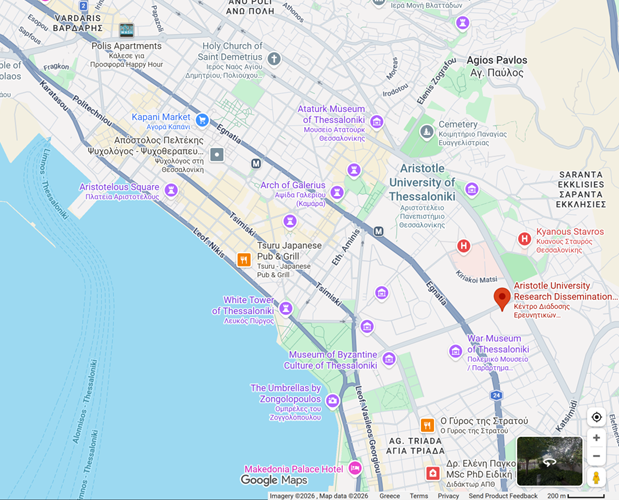
Also, we’d like to point out that, on November 5th, the International Film Festival takes place (5-15 November, 2026) , which causes high demand for accommodation on the days of the festival, as well as, those approaching the festival, therefore we advise you to book your accommodation as early as possible.
About Thessaloniki
The ManagiDiTH Final Conference will be held in the historic city of Thessaloniki in Greece. As the country’s second-largest city and cultural co-capital, Thessaloniki is renowned for its rich history, impressive Ancient Greek, Roman, and Byzantine monuments, lively shopping districts, distinctive local gastronomy, and vibrant nightlife.
Founded in 315 BC, the city was named after the ancient Greek princess Thessaloniki, sister of Alexander the Great. For over 2,300 years, Thessaloniki has been a meeting point of cultures, civilizations, and traditions.
Known for its numerous festivals, artistic events, and dynamic cultural scene, Thessaloniki is widely regarded as the cultural capital of Greece and offers visitors a unique blend of history and contemporary urban life.
Further information about Thessaloniki can be found at the Visit Greece website.
City Attractions & Landmarks
Top 5 Attractions in Thessaloniki
- The White Tower of Thessaloniki, the city’s most iconic landmark, hosts an exhibition on the history and art of Byzantine Thessaloniki covering the period from 300 to 1430 AD.
- The Roman monuments of Thessaloniki, dating back to the early 4th century AD, including the Rotunda, the Arch of Galerius, and the Roman Forum.
- Museum of Byzantine Culture: One of Greece’s most important museums, featuring exceptional Byzantine art, including priceless icons, frescoes, sculptures, jewelry, manuscripts, pottery, and coins.
- Archaeological Museum of Thessaloniki: One of the city’s most visited museums, located near the White Tower. Its collections include artifacts and sculptures from the Archaic, Classical, Hellenistic, and Roman periods.
- The picturesque district of Ladadika and the city’s waterfront area, known for their lively atmosphere, restaurants, cafés, and historic character.
Top 5 Activities in Thessaloniki
- Explore the city’s numerous Byzantine churches, many of which are designated UNESCO World Heritage Sites.
- Visit Mount Athos, the renowned monastic community and spiritual center of Eastern Orthodoxy (accessible by men only).
- Discover Vergina, the ancient site of Aigai, the first capital of Macedonia, featuring extensive archaeological remains, including the royal tomb of King Philip II and the palace complex.
- Visit Halkidiki, famous for its picturesque villages, crystal-clear waters, and beautiful beaches.
- Enjoy the local gastronomy, international cuisine, and excellent regional wines.
- Experience shopping in the city’s vibrant commercial districts.
- Discover Thessaloniki’s famous nightlife, with its wide variety of cafés, bars, restaurants, and music venues.
Sightseeing and Leisure in Thessaloniki
BYZANTINE MONUMENTS
Thessaloniki, with its host of Byzantine monuments (due to its significance during the Byzantine period), justifiably is considered an open-air museum of Byzantine art. Wandering through the city, it is worthwhile to see:
- The churches of Acheiropoietos a three-aisled, timber-roofed basilica,.
- The Holy Wisdom of God (Hagia Sophia) (7th century),.
- The Panaghia (Virgin) Chalkeon (1028),.
- Hosios David (12th century), St Panteleemon (late 13th or the early 14th century), is of four-columned cross-in-square type,.
- Panagouda a three-aisled basilica with significant icons,.
- Agios Ioannis Prodromos, Vlatadon monastery a 14th century foundation of which only the katholikon and two cisterns within the precinct survive,.
- Agios Dimitrios a splendid basilica dedicated to the patron saint and protector of the city, etc.
- The byzantine walls of the city.
- The archaeological site in 3 Septemvriou St., with remnants of a cemetery basilica, a martyr and Early Christian graves.
- The byzantine bathhouse (late thirteenth century).
- The Heptapyrgion castle was raised in stages, from the early years of the Byzantine Age into the Ottoman period.
Thessaloniki museums
Thessaloniki is home to a remarkable variety of museums reflecting the city’s rich historical and cultural heritage. Archaeological Museum of Thessaloniki presents outstanding artifacts from ancient Macedonia, including sculptures, gold treasures, ceramics, and findings dating from prehistoric times to the Roman era.
Museum of Byzantine Culture, one of Greece’s most important museums, showcases exceptional collections of Byzantine art and everyday objects spanning the Early Christian period to the Ottoman era.
Jewish Museum of Thessaloniki highlights the long and significant presence of the Jewish community in Thessaloniki, documenting its history, culture, and tragic destruction during World War II.
For contemporary art enthusiasts, Macedonian Museum of Contemporary Art features an important collection of paintings, sculptures, photography, installations, and multimedia works by Greek and international artists.
Together, these museums offer visitors a fascinating journey through the history, art, and multicultural identity of Thessaloniki.
Culture and Events
Thessaloniki has a vibrant and continuously evolving cultural scene, combining historic institutions with contemporary creative spaces and a strong festival culture.
Thessaloniki Concert Hall remains one of the city’s leading venues for classical music, opera, conferences, and large-scale cultural productions, hosting both Greek and international artists throughout the year.
In recent decades, former industrial sites have been transformed into important cultural hubs. The city’s cultural identity is also strongly shaped by contemporary art institutions. Thessaloniki is particularly known for its dynamic festival calendar, including internationally recognized events such as the Thessaloniki International Film Festival, the Dimitria Festival, and numerous music, street culture, and arts festivals that take place throughout the year.
Together, these elements make Thessaloniki one of the most active cultural centers in Southeastern Europe, where heritage, contemporary creativity, and urban culture coexist.
Dining and Nightlife
Aristotelous Square – surrounded by monumental buildings and open to the waterfront for a width of 100 meters and the waterfront avenue of the city (Nikis avenue), where cafes, trendy bars, restaurants and street performers can be found.
Navarinou Square – Full of university student’s haunts (open air cafes overlooking the ruins of the im
Valaoritoy district – The new trendy neighborhood where restaurants, bars and live music scenes.
Bar rows in the city center – cluster of bars with distinct character can be found at Lori Margariti, Nikiforou Foka, Zefxidos and Valaoritou streets.
Thessaloniki is widely regarded as one of the most vibrant nightlife destinations in Greece, offering a dynamic mix of traditional tavernas, modern restaurants, stylish cocktail bars, live music venues, and seaside cafés.
The city’s seafront, from Aristotelous Square along Nikis Avenue, is a focal point of social life, with cafés and bars overlooking the Thermaic Gulf and remaining lively from morning until late at night. The area is especially popular for sunset views and relaxed evening drinks.
Nearby, Navarinou Square continues to be a popular meeting point, shaped by its strong student presence and relaxed atmosphere, with cafés and informal bars built around archaeological remains and open public space.
The Valaoritou district has developed into one of the city’s main nightlife hubs, known for its concentration of cocktail bars, creative venues, and live DJ sets, attracting both locals and visitors. Small bar clusters across the city centre offer a wide variety of experiences.
Overall, Thessaloniki’s nightlife reflects its youthful energy and cultural diversity, combining historic surroundings with a constantly evolving urban entertainment scene.
Shopping
Thessaloniki offers a diverse and lively shopping experience, ranging from traditional markets to modern retail streets and boutique districts.
The historic Modiano, Kapani, and Athonos Market Halls are among the city’s most atmospheric shopping areas. These covered markets are known for their vibrant character, offering fresh local produce, spices, delicacies, and affordable goods. The surrounding area is also filled with traditional tavernas and small eateries, many of which feature local cuisine and a lively, authentic atmosphere.
Tsimiski Street is the city’s main commercial avenue, lined with well-known international brands, fashion retailers, and local shops. It represents the heart of modern retail in Thessaloniki, combining high-street shopping with easy access to cafés and urban life.
Across the city, traditional pastry shops remain an essential part of the Thessaloniki experience, offering a wide variety of sweets and desserts, each with its own signature recipes and local character.
Useful information
Getting to and from the airport
You can reach the airport using the following bus routes:
- Line 1X / 1N: Runs between the airport and Thessaloniki city centre, stopping at the New Railway Station and the KTEL Makedonia intercity bus station.
- Line 2X: Links the airport with the Nea Elvetia metro station, where you can transfer to the metro system.
The bus stop is situated in the arrivals section, right outside Exit 4 of Terminal 1.
A single ticket costs €2.00 and can be bought either at the on-site ticket counter or from the OSETH automatic ticket machines.
As an alternative, taxis are available and typically cost around €20–25 to reach the city centre.
Getting around Thessaloniki
- Thessaloniki has a public transportation system. Getting around is feasible by bus, metro and taxis as they are easily available at low cost. Thessaloniki is not a huge city (population above 1,000,000 people). Hence, most famous attractions can be easily explored on foot.
General information
LANGUAGES
Most Greeks speak English.
PASSPORT / VISA
Passport and visa requirements vary from country to country. Delegates requiring a letter of invitation in order to attend the Conference may address themselves to the Scientific Secretariat. Please note that this procedure aims to assist delegates who need to obtain a visa or permission to attend the Conference. The invitation is strictly limited to visa issues and there is no connection, whatsoever, to financial support etc.
For more details please visit the site: http://www.mfa.gr/en/visas/ or the site http://www.mfa.gr/en/visas/visas-for-foreigners-traveling-to-greece/countries-requiring-or-not-requiring-visa.html
CURRENCY
Euro (EUR) is the currency of Greece
ELECTRICAL APPLIANCES
Electricity supply in Greece is 220-230 volts, 50 Hz.
TIME ZONE
Greece operates on Eastern European Time (EET, GMT+2). During the summer months, Daylight Saving Time (EEST, GMT+3) is observed. As the time changes back to EET at the end of October, the time zone on November 2–3 will be EET (GMT+2).
COUNTRY CODE
The international country code for Greece is +30, followed by the local phone number.
SHOPPING
Greece offers a wide variety of shopping opportunities, including local products, souvenirs, fashion, and international brands. Opening hours vary depending on the area and type of store. In general, shops operate Monday through Friday from 09:00 to 21:00 and on Saturdays from 09:00 to 15:00. Shops are closed on Sundays and many of them stay closed on Mondays and Wednesdays after 15.00.
Traveling formalities
HEALTH CARE AND SAFETY
Greece is generally a safe destination for visitors. Food and beverages served in hotels, restaurants, and cafés are subject to strict health regulations. Tap water is safe to drink in most parts of mainland Greece; however, bottled water is recommended in some island destinations.
Citizens of EU countries are advised to carry their European Health Insurance Card (EHIC), which provides access to necessary public healthcare services during their stay.
EMERGENCY CALLS
Emergency number: 112
Emergency ambulance service: 166
Find out On-Duty hospitals, clinics, doctors & pharmacies: 1434
WEATHER INFORMATION
Thessaloniki in early November usually experiences mild autumn weather, with daytime temperatures typically ranging between 15°C and 20°C, while evenings can be cooler, around 10°C to 13°C. Visitors are advised to bring light autumn clothing, along with a jacket or sweater for the evenings and occasional rainfall. Weather conditions are generally pleasant, making this period comfortable for sightseeing and outdoor activities.
Committees
Below you can find information about the committees.
General Conference Chairs
Savvas Anastasiadis
Leonor Domingos
André Filipe Xavier da Glória
Maria do Carmo Gomes
Evdokimos Konstantinidis
Ruusa Ligthart
Kristiina Rosqvist
Local Conference Chair
Panagiotis Bamidis
Scientific Committee
Outi Ahonen
Alexandra Anagnostopoulou
Savvas Anastasiadis
Panagiotis Antoniou
Alkinoos Athanasiou
Panagiotis Bamidis
Alexander Berler
Antonis Billis
Ermis Christodoulou
Eleni Dafli
Nuno David
Jose Miguel Dias Pereira
Leonor Domingos
André Filipe Xavier da Glória
Sotiria Gylou
Mitha Jose
Valdemar Kallunki
Haralampos Karanikas
Panagiotis Kartsidis
Smaranta Ketseridou
Evdokimos Konstantinidis
Ruusa Lighthart
Tuija Marstio
Ana Lúcia Martins
Anssi Mattila
Nuno Nunes
Sancho Oliveira
Niki Pandria
Emmanouil Papanastasiou
João Pedro Pavia
Thiago Bessa Pontes
Octavian Postolache
António Raimundo
Jyri Rajamaki
Sofia Reppou
Emmanouil Rigas
Mariana Jacob Rodrigue
Kristina Rosqvist
Carlos Serrão
Pedro Sebastião
Nafsika-Georgia Servitzoglou
Anastasios Siountas
Stergiani Spyrou
Haris Styliadis
Georgios Tsoulfas
Vasiliki Zilidou
Program Chairs
Savvas Anastasiadis
Panagiotis Bamidis
Evdokimos Konstantinidis
Emmanouil Papanastasiou
Organising Committee
Leonor Domingos
Tarja Laakkonen
Martina dos Santos Maher
Maria Nikolaidou
Vasiliki Pavlidou
Sofia Reppou
Margarida Couto Santos
Iraklis Tsoupouroglou
Publication Chairs
Panagiotis Bamidis
Sofia Reppou
Local Organizer and Finance Chair
Maria Nikolaidou
Contact us
You can send questions about the conference here:
dith2026@med.auth.gr
Join us in shaping the future of digital health innovation!

General Agenda
(*agenda may be subject to change)
MONDAY Day 1 (November 2nd)
Opening ceremony
Objective:
Activities
- 09:30 – 10:00 (location)
Registration – Pick up your name badges and welcome kits!
- 10:00 – 10:15 (location)
N/A
- 10:15 – 10:30 (location)
N/A
- 10:30 – 11:00 (location)
N/A
- 11:00 – 11:30 (location)
Coffee break
- 11:30 – 12:15 (location)
N/A
- 12:15 – 13:00 (location)
N/A
- 13:00 – 14:00 (Cafeteria)
Lunch
- 14:00 – 14:15 (location)
N/A
- 14:15 – 14:30 (location)
N/A
- 14:30 – 15:30 (location)
N/A
- 15:30 – 16:00 (location)
N/A
TUESDAY Day 2 (November 3rd)
Graduation Ceremony
Objective:
Activities
- 09:00 – 09:30 (location)
N/A
- 09:30 – 10:15 (location)
N/A
- 10:15 – 10:30 (location)
N/A
- 10:30 – 11:00 (location)
N/A
- 11:00 – 11:30 (location)
Coffee break
- 11:30 – 13:00 (location)
N/A
- 13:00 – 14:00 (location)
Lunch
- 14:00 – 16:00 (location)
N/A
WEDNESDAY Day 3 (January 28th)
Innovation Bootcamp: Ideation and prototyping
Objective: Collaborative creation, ideation, testing of ideas and development of prototypes.
Activities
- 09:30 – 10:00 (Lobby)
Registration
- 10:00 – 10:30 (Auditorium)
Intro for the day
- 10:30 – 11:00 (Campus park)
Coffee break
- 11:00 – 13:00 (TBC)
Teamwork – Ideation, testing ideas, selecting the best ones
- 13:00 – 14:00 (Cafeteria)
Lunch
- 14:00 – 15:30 (TBC)
Teamwork – Prototyping
- 15:30 – 16:00 (TBC)
Coffee break
- 16:00 – 17:45 (TBC)
Teamwork – Prototyping and testing
- 18:00
Campus closes
THURSDAY Day 4 (January 29th)
Innovation Bootcamp: Concept creation
Objective: Collaborative creation, and concept creation.
Activities
- 09:00 – 09:30 (Lobby)
Registration
- 09:30 – 10:15 (Auditorium)
Keynote Session – Digital Transformation in Healthcare: Smart Physical Therapy with Prof. Octavian Postolache from Instituto de Telecomunicações (IT)
- 10:15 – 10:30 (Auditorium)
Intro for the day
- 10:30 – 11:00 (Campus park)
Coffee break
- 11:00 – 13:00 (TBC)
Teamwork – Concept building
- 13:00 – 14:00 (Cafeteria)
Lunch
- 14:00 – 15:30 (TBC)
Team work – Creating a presentation
- 15:30 – 16:00 (Campus park)
Coffee break
- 16:00 – 17:45 (TBC)
Teamwork – Documentation, final rehearsal
- 18:00
Campus closes
FRIDAY Day 5 (January 30th)
Showcasing results
Objective: Final presentations and closing ceremony of Winter School and Innovation Bootcamp.
Activities
- 09:00 – 09:30 (Lobby)
Registration
- 09:30 – 09:40 (Auditorium)
Intro for the day
- 09:40 – 11:00 (Auditorium)
Final presentations
- 11:00 – 11:45 (TBC)
Coffee break
- 11:45 – 13:00 (Auditorium)
Final presentations continue
- 13:00 – 13:15 (Auditorium)
Sum up of the Innovation Bootcamp and feedback
- 13:15 – 13:30 (Auditorium)
Closing of the event – Final speeches from the masters’ programme committee members Prof. Margarida Santos from Iscte – University Institute of Lisbon, Prof. Ruusa Ligthart from Laurea University of Applied Sciences and Prof. Octavian Postolache from IT.
- 13:30 – 14:30 (Cafeteria)
Lunch
End of the Winter School and Innovation Bootcamp 2026
Acknowledgement
ManagiDiTH Master Programme Universities Conference Digital Transformation in Health 2026, held at Aristotle University of Thessaloniki, Greece, at November 02-03, is co-financed by the European Commission and the ManagiDiTH Project partners: Iscte – Instituto Universitário de Lisboa, Aristotle University of Thessaloniki (AUTH), Laurea University of Applied Sciences, Instituto de Telecomunicações (IT), Mundi Consulting, Clinipower, and Whymob.